Two ways to feed, two calculator modes. If you use ready-made AB Mix, use the first mode to work out the stock solution dose for your reservoir volume. If you blend your own from single fertilizers, the second mode works out the grams of each ingredient and shows how many ppm of each nutrient element you actually get.

Filling Dose
- Reservoir volume
- -
- Stock solution A
- -
- Stock solution B
- -
- Estimated TDS reading
- -
- Recommended pH
- -
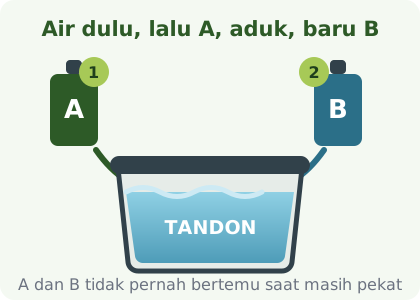
The order: fill the reservoir with water, pour in stock solution A, stir until even, then pour in stock solution B. Never pour A and B side by side while they are still concentrated.
Running Solution Correction
The Save PDF button opens the print dialog. Choose the destination Save as PDF, and the file is saved on your own device. Nothing is stored on this website.
Blend Result
- Volume per tank
- -
- Enough for
- -
- Dose when used
- -
- Fertilizer weight, tank A
- -
- Fertilizer weight, tank B
- -
- Total fertilizer weight
- -
Shopping List
| Fertilizer | Needed | Prepare |
|---|
Column Prepare rounded up to sensible purchase units. Single fertilizers are usually sold by the kilogram at farm supply shops and online marketplaces, while micronutrients come in small packs.
Tank A calcium
| Fertilizer | Type | Weight |
|---|---|---|
| Total | - |
Tank B sulfate & phosphate
| Fertilizer | Type | Weight |
|---|---|---|
| Total | - |
Nutrient Comparison
| Element | Target PPM | Result PPM | Difference |
|---|
The weights above are for one stock tank, not for the reservoir water. Dissolve tank A and tank B separately, then use them at the dose given in the summary.
The Save PDF button opens the print dialog. Choose the destination Save as PDF, and the file is saved on your own device. It holds this dose along with the blending order and its illustrations. Nothing is stored on this website.
How to Use Ready-Made AB Mix
Five steps from an empty reservoir to a solution ready to circulate
-
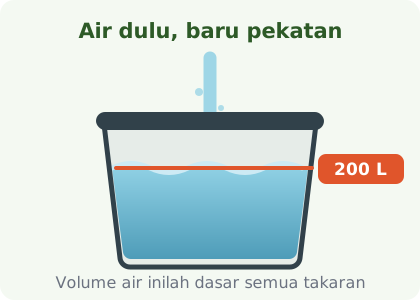
Fill the reservoir with water first
Write down how many liters actually go in, because that number is the basis of every dose. Do not pour the stock solution into an empty reservoir and add the water afterwards, because undiluted stock solution can damage roots if the pump draws it in.
-
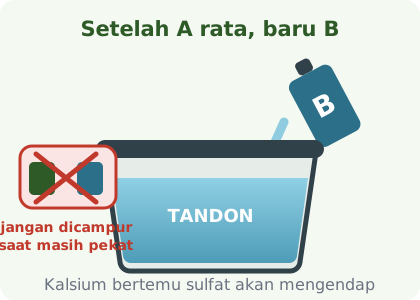
Pour in stock solution A, then stir
Pour slowly while the water is stirred, not all in one spot. Wait until the color is even before going on. Rushing this step is the most common cause of precipitate.

-
Only then pour in stock solution B
Once A is fully dissolved, B goes in. Never pour the two at the same time, and never mix them first in a small bucket. While concentrated, calcium from A meets sulfate from B and settles out as white grains the plants cannot take up.
-
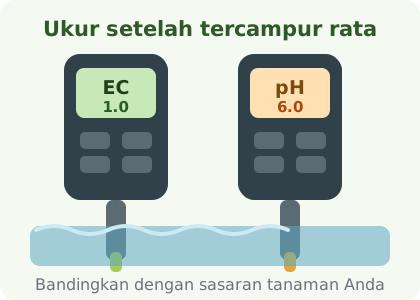
Measure EC and pH
Give the solution a short while to circulate, do not measure right after pouring. Compare the reading with your crop range in the reference table. If the EC is off, the correction fields in the calculator work out the adjustment.
-
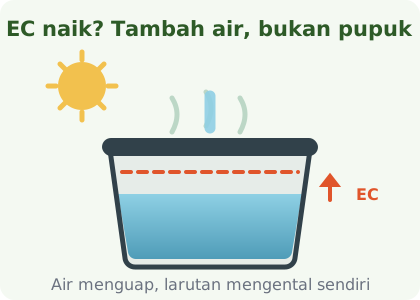
Check again every day
Water evaporates all day while the fertilizer salts stay behind. The solution concentrates on its own and the EC rises even though you added nothing. What you add to bring it down is fresh water, not fertilizer.
How to Make Your Own AB Mix: The Right Blending Order
The step most often skipped, and the white precipitate at the bottom of the tank that follows
-
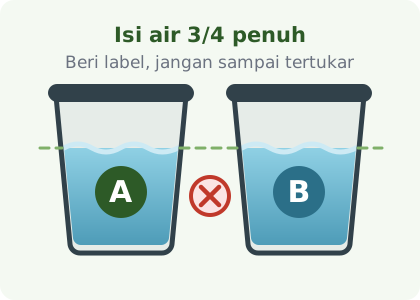
Set up two separate tanks
Label them A and B so they do not get swapped. Fill each with clean water to about three quarters of its final volume. Hard well water is better settled or filtered first.
-
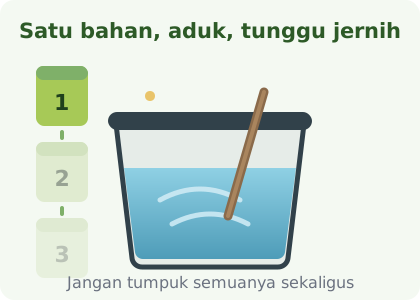
Dissolve one at a time, not all at once
Add the first fertilizer, stir until it is fully dissolved and the water is clear again, then add the next. Dumping everything in at once leaves part of it settled out and the dose off.
-
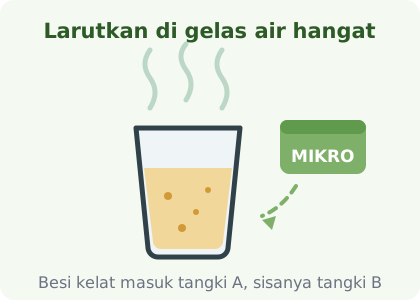
Dissolve micronutrients first in a small glass
The amounts are very small, so dissolve them in a glass of warm water until clear, then pour into tank B. Chelated iron goes into tank A so it does not meet phosphate.
-
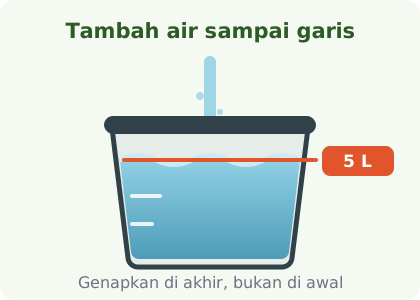
Top up to volume, do not guess
Once everything is dissolved, add water up to exactly the volume you planned. Topping up at the start makes the last fertilizer hard to dissolve.
-
When using, dilute one after the other
Reservoir water first, then stock solution A, stir, then stock solution B. Calcium from A and sulfate from B are only safe to meet once both are diluted.
-
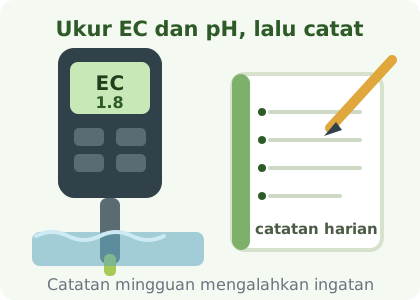
Measure, then write it down
Measure EC and pH after the solution is evenly mixed, not right after pouring. Write the readings down. A weekly record is far more useful than trying to remember.
AB Mix Dose per Liter of Water for Each Crop
The most common question, answered with numbers
Every figure below is the dose of stock solution A and stock solution B, that much of each. For 1 liter of water on lettuce, that means 1.7 to 2.5 ml of solution A plus 1.7 to 2.5 ml of solution B. Not split in half, and not mixed together first.
| Crop | Target EC (mS/cm) | A and B dose per 1 liter | Per 2 liters | Per 10 liters |
|---|---|---|---|---|
| Sowing / seedlings | 0.5 - 0.8 | 1 - 1.7 | 2 - 3.3 | 10 - 17 |
| Lettuce | 0.8 - 1.2 | 1.7 - 2.5 | 3.3 - 5 | 17 - 25 |
| Basil | 1.0 - 1.6 | 2.1 - 3.3 | 4.2 - 6.7 | 21 - 33 |
| Strawberry | 1.4 - 2.0 | 2.9 - 4.2 | 5.8 - 8.3 | 29 - 42 |
| Pak choi / mustard greens | 1.5 - 2.0 | 3.1 - 4.2 | 6.3 - 8.3 | 31 - 42 |
| Water spinach | 1.5 - 2.0 | 3.1 - 4.2 | 6.3 - 8.3 | 31 - 42 |
| Cucumber | 1.7 - 2.5 | 3.5 - 5.2 | 7.1 - 10.4 | 35 - 52 |
| Spinach | 1.8 - 2.3 | 3.8 - 4.8 | 7.5 - 9.6 | 38 - 48 |
| Melon, vegetative stage | 1.8 - 2.2 | 3.8 - 4.6 | 7.5 - 9.2 | 38 - 46 |
| Celery | 1.8 - 2.4 | 3.8 - 5 | 7.5 - 10 | 38 - 50 |
| Tomato, vegetative stage | 2.0 - 2.5 | 4.2 - 5.2 | 8.3 - 10.4 | 42 - 52 |
| Chili | 2.0 - 3.0 | 4.2 - 6.3 | 8.3 - 12.5 | 42 - 63 |
| Melon, generative stage | 2.4 - 3.0 | 5 - 6.3 | 10 - 12.5 | 50 - 63 |
If You Want to Blend Your Own
Buying ready-made AB Mix is the easiest route, but the cost per liter of solution drops a long way once you blend from single fertilizers. The ingredients are Calcium Nitrate, KNO3, MKP, Magnesium Sulfate, Potassium Sulfate, and six micronutrients, all sold openly in Indonesian farm supply shops. The Blend Single Fertilizers mode in the calculator works out the grams of each ingredient for the stock volume you want, splits them into Tank A and Tank B, then shows how many ppm of each nutrient element you actually get against the target. The working order is in the guide to making your own AB Mix on this page.
Reference Tables
The figures the calculator above uses, opened up so you can check them
EC, PPM, and pH per Crop
| Crop | EC (mS/cm) | PPM, 500 scale | PPM, 700 scale | pH |
|---|
Single Fertilizers Sold in Indonesia
| Fertilizer | Formula | Trade label | Elements counted | Tank | Source of figures |
|---|
Assumptions and Limits
So you know exactly where this tool can be trusted, and where it cannot
- EC is proportional to the dose. The first mode assumes twice the dose gives twice the EC. That assumption is accurate over the normal hydroponic working range, and starts to drift on very concentrated solutions.
- Source water is assumed clean. The calculator starts from zero EC. If your well water is already 0.3 mS/cm before any fertilizer, subtract that from the target EC, and remember that the calcium it already carries adds to the total.
- Temperature is not accounted for. An EC meter without temperature compensation reads higher when the solution is warm. Measure at the same time every day.
- pH is not calculated. Raising or lowering pH takes a separate acid or base, and the amount depends on the buffering capacity of your water.
- The blend follows a fixed order. Calcium is set first, then phosphorus, magnesium, nitrogen, and potassium last. That is why the comparison table is shown, so any remaining gap is visible instead of hidden.
= 640 ppm on the 640 scale
= 700 ppm on the 700 scale
The meter scale is stated in its manual. If in doubt, just use EC.
Free to Use and Share
Free for anyone. If it helps, just include a link back to the source
Use this calculator to teach, to put together training material, or to train farmer groups. There is no need to ask permission. We only hope your readers can find the original source.
AB Mix Nutrient Calculator - Cirebon Smart Farm https://www.cirebonsmartfarm.com/kalkulator-nutrisi-ab-mix.html
<a href="https://www.cirebonsmartfarm.com/kalkulator-nutrisi-ab-mix.html">AB Mix Nutrient Calculator</a> by Cirebon Smart Farm
Questions About Nutrients
What hydroponic beginners ask most
How much AB Mix for 1 liter of water?
For the AB Mix stock solutions commonly sold in Indonesia, the dose is usually 5 ml of solution A plus 5 ml of solution B per 1 liter of water. The exact figure depends on the product strength and the crop target EC. Measure the EC of the diluted solution with a meter, then enter the result in the calibration field in the calculator so the dose is right for your product.
Why can solutions A and B not be mixed directly?
Solution A contains calcium, solution B contains sulfate and phosphate. While concentrated, the calcium reacts into calcium sulfate and calcium phosphate, which settle out and cannot be taken up by plants. White precipitate at the bottom of the tank almost always comes from this mistake. The two may only meet once each of them is diluted in the reservoir.
What EC and PPM are right for lettuce?
Lettuce grows well at EC 0.8 to 1.2 mS/cm. On a 500 scale TDS meter that is 400 to 600 ppm, while on the 700 scale it is 560 to 840 ppm. The recommended pH is 5.5 to 6.5. Ranges for other crops are in the reference table on this page.
Why does the PPM on my meter differ from the guide?
A TDS meter does not measure ppm directly. It measures EC and multiplies it by a factor. Cheap meters usually use the 500 scale, some other brands use 640 or 700. The same solution can read 1000 ppm on one meter and 1400 ppm on another when the contents are exactly the same. So record EC, not just ppm.
How do I bring down an EC that has gone too high?
Only by adding fresh water, never by adding any fertilizer. The correction fields in the calculator work out how many liters of water to add. Remember that the reservoir volume rises too, so make sure there is still capacity. Add it in stages, stir, then measure again.
Which single fertilizers do I need to blend my own?
The main ingredients are Calcium Nitrate, Potassium Nitrate or KNO3, MKP or Mono Potassium Phosphate, and Magnesium Sulfate, known as Epsom salt. The balancer is Potassium Sulfate, sometimes with ammonium sulfate added. For micronutrients you use Fe-EDTA, Manganese Sulfate, Zinc Sulfate, Copper Sulfate, Borax, and Sodium Molybdate. All of them are available at farm supply shops and domestic online marketplaces.
Which fertilizers go in Tank A and which in Tank B?
Tank A holds Calcium Nitrate, Potassium Nitrate, and chelated iron. Tank B holds MKP, Magnesium Sulfate, Potassium Sulfate, and the micronutrients other than iron. This split keeps calcium from meeting sulfate and phosphate while they are still concentrated. The calculator already separates them in the result table.
How much AB Mix for 2 liters of water?
Double the per-liter dose. For lettuce with a target EC of 0.8 to 1.2 mS/cm, 2 liters of water needs about 3.3 to 5 ml of stock solution A plus 3.3 to 5 ml of stock solution B. For hungrier water spinach or mustard greens, about 6.3 to 8.3 ml of each.
That dose holds if your stock solution gives EC 2.4 mS/cm at 5 ml per liter, which is the most common on the market. A volume as small as 2 liters is hard to measure with a kitchen cup, so use a 10 ml needleless syringe. Half a milliliter off at this volume already shifts the EC a fair way.
What is hydroponic AB Mix made of?
AB Mix is two concentrated solutions of fertilizer salts dissolved in water. Solution A holds Calcium Nitrate as the source of calcium and nitrogen, Potassium Nitrate, and iron in chelated form such as Fe-EDTA. Solution B holds MKP as the source of phosphorus, Magnesium Sulfate or Epsom salt, Potassium Sulfate, and micronutrients in the form of Manganese Sulfate, Zinc Sulfate, Copper Sulfate, Borax, and Sodium Molybdate.
There is nothing secret in it. What separates one brand from another is only the ratio of each ingredient and the purity of the fertilizers. That is why you can make AB Mix yourself, and the whole composition is laid open in the calculator on this page.
How much AB Mix for water spinach, mustard greens, and pak choi?
All three are fast-growing leafy greens that tolerate a fairly concentrated solution. The target EC is 1.5 to 2.0 mS/cm, equal to 750 to 1000 ppm on a 500 scale TDS meter. The dose is about 3.1 to 4.2 ml of stock solution A plus 3.1 to 4.2 ml of stock solution B for each liter of water.
Start at the lower limit when the seedlings have just been transplanted, then raise it in stages once the roots push through the media. Water spinach that is harvested several times usually wants the EC a little higher each time new shoots appear.
What PPM for romaine, green leaf, and red leaf lettuce?
Every type of lettuce is kept in the same range, EC 0.8 to 1.2 mS/cm. On a 500 scale TDS meter that is 400 to 600 ppm, on the 700 scale it becomes 560 to 840 ppm. Romaine, green leaf, curly leaf, and red leaf lettuce do not ask for different figures.
What really differs between types is their sensitivity to temperature, not the nutrient strength. Red leaf lettuce holds its color better on cold nights, and romaine turns bitter faster if the solution is left too concentrated in hot weather. If the leaves start to taste bitter, lower the EC to the bottom of the range, not the other way around.
What source water PPM is still safe for hydroponics?
Source water is best below 200 ppm on the 500 scale, or EC below 0.4 mS/cm. Well water in many areas sits at 100 to 300 ppm, and municipal tap water is often higher. Above 400 ppm the room left for fertilizer gets narrow, especially for lettuce, whose target is low.
The thing to understand is that the source water EC is already counted before a single drop of fertilizer goes in. The calculator on this page subtracts the source water EC from the target EC, so the dose it gives already accounts for it. If your water is very high, filter it with RO or blend it with rainwater collected clean.
Can I make my own hydroponic nutrients from natural materials?
You can, but the result is not AB Mix and cannot be worked out with this calculator. Liquid organic fertilizer from livestock manure, leachate, or fermented kitchen waste supplies nutrients in a form that bacteria still have to break down first. The content changes from batch to batch and a TDS meter does not read it as available nutrients.
If your aim is to cut costs, the more measurable route is blending your own from single fertilizers. The ingredients are still mineral salts, as in factory AB Mix, the price per liter of solution is far lower, and every element can be worked out down to ppm. That is what the Blend Single Fertilizers mode on this page does.
Are the figures I enter saved?
No. All the calculation runs in your browser. This website is a static page with no database, so no numbers are sent or stored anywhere.
Other Tools and Guides
All free and open
Biofloc Pond Calculator
Pond volume, number of fingerlings, feed needs, and fish density at harvest.
Biofloc Guide
The nitrogen cycle, C:N ratio, equipment list, and the stages of setting up a pond.
Our Products
Hami melon and hydroponic lettuce grown with measured nutrients like these.
Ask Us
Is there a figure that does not match your experience? We are glad to be corrected.