You Are Raising Water, Not Raising Fish
An old saying that happens to be true
Almost every failure in fish farming starts with the water, not with disease. Disease usually comes later, after the water has already stressed the fish. So this first module is not about fish, it is about the eight numbers that decide whether they live or die.
What separates an experienced farmer from a beginner is not the ability to treat, but the habit of measuring before anything gets sick.
| Parameter | Safe range | Danger limit | How often to measure |
|---|---|---|---|
| Dissolved oxygen (DO) | Above 4 mg/L | Below 3 mg/L | Every day, especially before dawn |
| Water temperature | 26 to 30 degrees | Above 33 or below 22 | Morning and afternoon |
| pH | 6.5 to 8.0 | Below 6 or above 8.5 | Morning and afternoon |
| Un-ionized ammonia (NH3) | Below 0.02 mg/L | Above 0.05 mg/L | Two to three times a week |
| Nitrite (NO2) | Below 0.5 mg/L | Above 1 mg/L | Twice a week, more often at the start |
| Alkalinity | 100 to 150 mg/L CaCO3 | Below 50 mg/L | Once a week |
| Floc volume | 20 to 40 ml/L | Above 50 ml/L | Every day in a biofloc system |
| Water clarity | 25 to 35 cm | Below 20 cm | Twice a week |
Ammonia, the Number Most Often Misread
Your test kit measures total ammonia, but only a small part of it kills
Ammonia in water exists in two forms that balance each other. Ammonium (NH4+) is relatively safe. Un-ionized ammonia (NH3) is toxic, damages the gills, and is lethal at very low levels. The test kits sold in shops measure both at once, which is called total ammonia or TAN.
The ratio between the two is set by pH and temperature. The higher the pH, the larger the share in the toxic NH3 form. This is why two ponds with exactly the same ammonia reading can end up very differently.
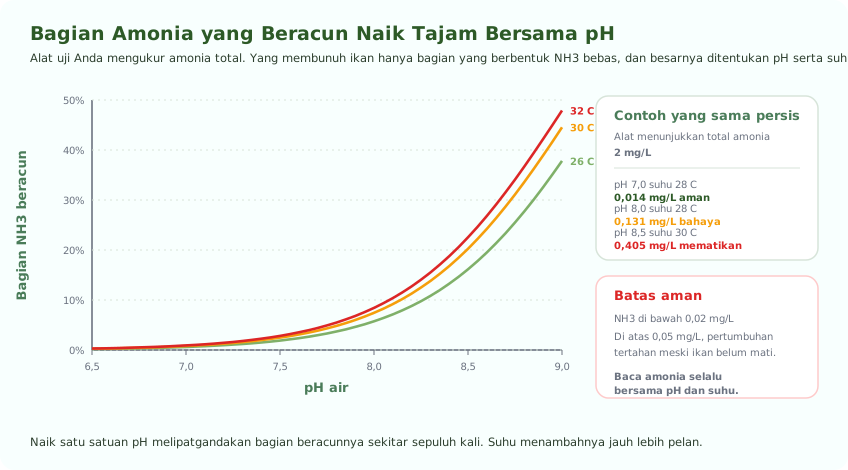
Percentage of toxic ammonia out of total ammonia
| pH | Temperature 26 degrees | Temperature 28 degrees | Temperature 30 degrees | Temperature 32 degrees |
|---|---|---|---|---|
| 6.5 | 0.19 | 0.22 | 0.25 | 0.29 |
| 7.0 | 0.60 | 0.69 | 0.80 | 0.91 |
| 7.5 | 1.89 | 2.16 | 2.48 | 2.83 |
| 8.0 | 5.74 | 6.54 | 7.43 | 8.42 |
| 8.5 | 16.14 | 18.12 | 20.25 | 22.53 |
| 9.0 | 37.83 | 41.16 | 44.53 | 47.91 |
If ammonia is already high
-
Stop the feed first, do not add anything
Feed is the source of ammonia. Fast the fish for one to two days. Healthy fish withstand fasting far longer than they withstand ammonia.
-
Do not rush to raise the pH
If the pH is low, it is actually protecting your fish, because it holds the ammonia in the ammonium form. Raising the pH suddenly while ammonia is high can kill a whole pond within hours.
-
Increase aeration
Enough oxygen speeds up the bacteria that convert ammonia. Fish under ammonia stress also need more oxygen than usual.
-
Add a carbon source in a biofloc system
Molasses pushes heterotrophic bacteria to take up ammonia as floc protein. This is the fastest way to bring ammonia down, and it is explained in the next module.
-
Change part of the water if all of the above is still not enough
Replace 10 to 20 percent with water that has been settled and is close in temperature. One large change at once stresses the fish because the shift is sudden.
pH and Alkalinity
Two different things often taken as the same
pH tells you how acidic the water is at that moment. Alkalinity tells you how strongly the water holds the pH from changing. A pond with low alkalinity can have a good pH this morning and then go into free fall this afternoon.
In a biofloc system, alkalinity is used up by the process too. Every gram of ammonia converted by nitrifying bacteria consumes about 7 grams of alkalinity. If it is never topped up, alkalinity thins out, the pH falls with it, and the bacteria stop working right when you need them most.
| What happens | Most common cause | What to do |
|---|---|---|
| pH low in the morning, high in the afternoon, gap over 1 | Low alkalinity and heavy algae | Add lime to raise alkalinity, cut the light coming in |
| pH keeps falling week after week | Alkalinity used up by nitrification | Add agricultural lime or dolomite regularly |
| pH high above 8.5 all day | Very dense algae, deep green water | Put up a shade net, cut the feed, improve water mixing |
| pH drops suddenly after heavy rain | Acidic rainwater and low alkalinity | Cover the pond when it rains, keep alkalinity in reserve |
Measuring Properly
A meter used wrongly gives a false sense of safety
-
Measure oxygen before dawn, not at midday
The lowest oxygen point comes just before sunrise, after a whole night of fish, bacteria, and algae all breathing without photosynthesis. Midday figures always look good and tell you nothing.
-
Lower the DO meter to working depth, then wait
Measure at about half the water depth, not at the surface. Hold it still until the number stops moving, usually ten to thirty seconds. A number taken in a hurry is always higher than reality.
-
Measure at several points, not just one
Even a round pond three meters across can have a dead corner where oxygen is far lower. That is the spot that will kill fish first.
-
Calibrate the pH meter every week
Use pH 4.01 and 6.86 calibration fluids. Keep the probe in storage solution and never let it dry out, because a dry probe is ruined permanently within days.
-
Write it down, do not just look at it
A single number means nothing. What tells you there is a problem is the change from day to day. A plain notebook is enough.
Questions About This Module
What participants ask most often
What is a good pH for catfish pond water?
Between 6.5 and 8.0, and more important than that, steady. The gap between morning and afternoon pH should be no more than one unit. A pH that swings sharply every day does more damage than a slightly high pH that stays put.
If your pH swings a lot, the root is almost always low alkalinity. Adding lime to raise alkalinity to 100 to 150 mg/L CaCO3 will settle the pH on its own.
How do you lower the pH of catfish pond water naturally?
Reduce the cause first. High pH in a pond is almost always from algae that are too dense, taking up carbon dioxide during the day. Put up a shade net, cut back on excess feed, and improve water mixing.
Adding molasses also lowers pH slowly because it triggers heterotrophic bacteria. Avoid strong acids, because a sudden drop is far more dangerous than a stable high pH. One important warning: if ammonia is high, a low pH is actually protecting the fish, so do not touch it until the ammonia comes down.
How do you measure DO or dissolved oxygen properly?
Use a DO meter, measure just before dawn, at about half the water depth, and wait until the number stops moving. Measure at several points, including the corner where the water flow is weakest.
Midday figures always look good because the algae are photosynthesizing, so they are no use as a warning. What counts is the lowest point just before sunrise. Below 3 mg/L the fish start gathering at the surface, and by then it is already too late.
Why is my ammonia test low but the fish still die?
Because common test kits measure total ammonia, while only un-ionized ammonia, or NH3, is toxic. Its share is set by pH and temperature. At pH 7 only about 0.7 percent of the total is toxic, but at pH 8.5 it can be 18 to 20 percent.
For example, total ammonia of 2 mg/L at pH 7 and 28 degrees gives toxic ammonia of 0.014 mg/L, which is still safe. The same total at pH 8.5 and 30 degrees gives 0.405 mg/L, twenty times above the safe limit. Always read ammonia together with pH and temperature.
How much alkalinity does a biofloc pond need?
Between 100 and 150 mg/L CaCO3. Below 50 mg/L the pH drops easily and the bacteria that break down ammonia slow down.
Alkalinity is used up by the process too. Every gram of ammonia oxidized by nitrifying bacteria consumes about 7 grams of alkalinity, while a gram taken up by heterotrophic bacteria uses about 3.6 grams. That is why a biofloc pond needs lime added regularly, not just once at the start.
All the modules can be read in order or skipped through as needed. See the fish farming training list, or all training tracks.