Where the Nitrogen from Feed Goes
Only a quarter of it becomes fish flesh
The pellets you spread contain protein, and protein contains nitrogen. Fish store only about a quarter to a third of that nitrogen as flesh. The rest leaves through the gills and in the waste as ammonia, and stays in the water.
In a large earthen pond, nature handles the rest. In a tarpaulin pond at high stocking density, you have to handle it. There are three routes to choose from, and biofloc is one of them.
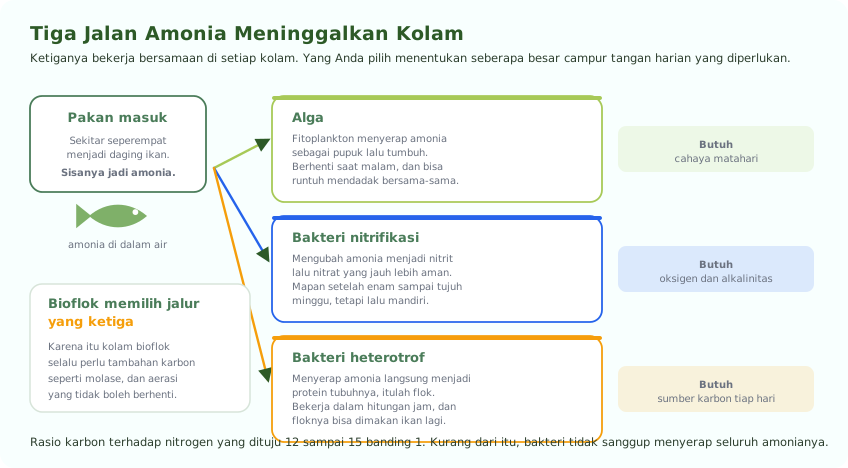
| Pathway | Organism | Speed | What it needs | Drawback |
|---|---|---|---|---|
| Algae (photoautotrophic) | Phytoplankton | Medium | Sunlight | Stops at night, prone to sudden crashes |
| Nitrification (autotrophic) | Nitrifying bacteria | Slow, established after 6 to 7 weeks | Oxygen and high alkalinity | Takes a long time to form |
| Biofloc (heterotrophic) | Heterotrophic bacteria | Fast, a matter of hours | A carbon source and strong aeration | Needs carbon added every day |
Calculating the Carbon You Have to Add
The part most often guessed at, even though there is a formula
Heterotrophic bacteria need carbon and nitrogen in a certain ratio to grow. If there is not enough carbon in the water, they cannot take up as much ammonia as you expect. The target ratio is usually 12 to 15 to 1.
The formula is simple. The carbohydrate you need to add equals the amount of nitrogen coming in, multiplied by the target C:N ratio, then divided by the carbon content of the carbon source.
| Carbon source | Carbon content | Usage notes |
|---|---|---|
| Molasses (cane molasses) | About 22 percent | Cheapest and most common, dissolves quickly |
| Table sugar | About 31 percent | Clean and easy to measure, but more expensive |
| Tapioca flour | About 46 percent | Has to be dissolved first, works more slowly |
| Fine rice bran | Varies | Cheap but the content is not uniform, adds solids |
A worked example you can copy
-
Calculate the nitrogen coming in through the feed
Say you feed 10 kg of feed at 30 percent protein. Protein contains about 16 percent nitrogen, so the nitrogen coming in is 10 kg times 0.30 times 0.16, which is 0.48 kg or 480 grams.
-
Subtract the part that becomes fish flesh
About 25 percent is stored in the fish body. The nitrogen that actually enters the water is about 75 percent, which is 360 grams.
-
Multiply by the target C:N ratio
With a target of 15 to 1, the carbon needed is 360 grams times 15, which is 5,400 grams of carbon.
-
Divide by the carbon content of the source
If you use molasses at 22 percent carbon, the molasses needed is 5,400 divided by 0.22, which is about 24.5 kg. This figure is for building floc from scratch.
-
For daily maintenance, use a shorter rule of thumb
Once the floc has formed, most farmers simply add 0.5 to 1 kg of carbon source for every 1 kg of additional feed. Measure floc volume and ammonia, then adjust from there.
Preparing a Pond from Scratch
The ten days that decide the rest of the cycle
-
Day 1, fill with water and let it settle
Fill the pond, run full aeration, and leave it two to three days so the chlorine gasses off and the water temperature matches the surroundings.
-
Day 3, raise the alkalinity
Measure the alkalinity. If it is below 100 mg/L CaCO3, add agricultural lime or dolomite until it is in the 100 to 150 range. This is the foundation that decides whether the bacteria will grow.
-
Day 3, add the probiotic and carbon source
Add the probiotic at the rate on the package, together with molasses. Some farmers also add a little feed as an early nitrogen source, so the bacteria have something to eat before the fish go in.
-
Days 4 to 9, let the bacteria build up
Aeration runs nonstop. The water will change from clear to cloudy brown. Add a little molasses each day, not all at once.
-
Days 7 to 10, test whether the water is ready
Let the water settle in an Imhoff cone for twenty minutes. A floc volume reading of 20 to 40 ml per liter means the pond is ready. Also make sure ammonia and nitrite are low and the pH is stable.
-
Only then stock the fingerlings
Stocking before the floc has formed means your fish carry the ammonia while the bacteria are still building up. This is the most expensive mistake, and the most common one.
Looking After the Floc Through the Cycle
Floc that is too dense is as much trouble as floc that is too thin
| Floc volume | What it means | Action |
|---|---|---|
| Below 10 ml/L | Not enough floc, ammonia at risk of rising | Add carbon source and probiotic, check aeration |
| 20 to 40 ml/L | Healthy, hold it there | Keep adding carbon in step with the feed amount |
| 40 to 50 ml/L | Getting heavy, watch the oxygen | Cut back the carbon, get ready to siphon |
| Above 50 ml/L | Too dense, oxygen at risk | Siphon the bottom sediment, drain part of the water, replace with clean water |
The sediment that piles up on the bottom is dead floc. It no longer takes up ammonia, but it still eats oxygen as it breaks down. That is why regular siphoning through the central drain pipe is not extra work, it is part of the maintenance.
If you want to work out pond volume, how many fingerlings fit, the feed requirement, and the harvest estimate all at once, biofloc pond calculator does all of it from the pond size you enter.
Questions About This Module
What participants ask most often
What is the molasses dose for a biofloc pond?
To build floc from scratch, calculate from the nitrogen coming in. 10 kg of feed at 30 percent protein brings in about 480 grams of nitrogen, and about 360 grams of that enters the water. With a target C:N ratio of 15 to 1, the carbon needed is 5,400 grams, and because molasses is about 22 percent carbon, the molasses needed is about 24.5 kg.
For daily maintenance once the floc has formed, the more practical rule is 0.5 to 1 kg of carbon source for every 1 kg of additional feed. Adjust from your floc volume and ammonia readings, not from the paper calculation alone.
What is floc in biofloc?
Floc is a living clump of bacteria, small algae, protozoa, and leftover organic matter stuck together. It forms when heterotrophic bacteria are given enough carbon, then take up ammonia from the water and turn it into their own body protein.
The benefit is twofold. The water is cleared of ammonia, and the floc itself can be eaten by the fish as extra feed. A healthy volume is 20 to 40 milliliters per liter, measured with an Imhoff cone after twenty minutes of settling.
How long before a biofloc pond is ready to stock fingerlings?
Seven to ten days after the probiotic and carbon source go in, with aeration running nonstop. The signs are water turning milky brown and a floc volume reading of 20 to 40 milliliters per liter in the Imhoff cone.
Do not stock before that. If the fingerlings go in while the floc has not formed, it is the fish that carry the ammonia while the bacteria are still building up. This is the most expensive mistake, and the most common one among beginners.
What is the difference between nitrifying bacteria and heterotrophic bacteria?
Nitrifying bacteria turn ammonia into nitrite and then nitrate. They work slowly and need six to seven weeks to become fully established, but once running they need nothing added beyond oxygen and alkalinity.
Heterotrophic bacteria take up ammonia directly into their body protein. They work much faster, a matter of hours, but they demand a carbon source added continuously and strong aeration. Biofloc rests on this second pathway.
Why is my biofloc pond water covered in thick foam?
Fine white or brownish foam that lasts a long time means dissolved protein is piling up, usually from too much feed or because the floc is too old and starting to break apart.
Cut the feed for one to two days, siphon the sediment through the central pipe, and add a little carbon source. Check the floc volume too, because thick foam almost always comes with floc above 50 milliliters per liter. Coarse foam with large bubbles that pop right away is only the aeration and is not dangerous.
All the modules can be read in order or skipped through as needed. See the fish farming training list, or all training tracks.