It All Starts in the Nursery
Mistakes here cannot be fixed later
Seedlings that are etiolated, hit by damping off, or stunted at the root will not recover once they are moved into the system, no matter how good the nutrients are. That is why a good farm handles this part with the most care.
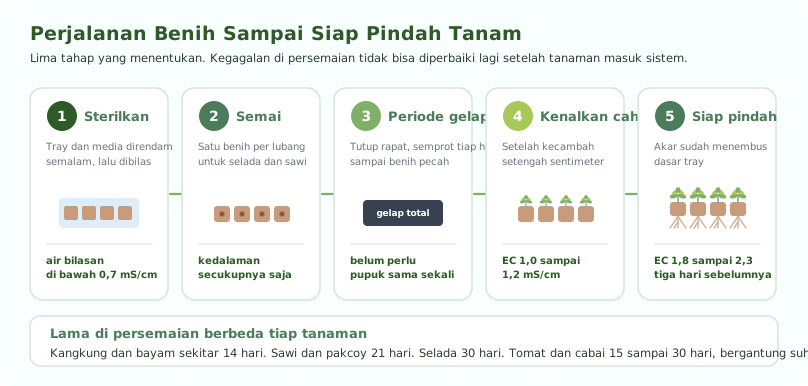
Four things decide it: cleanliness, the right media, a correct dark period, and nutrient strength that rises in stages.
Sterilizing Trays and Media
The step most often skipped, and most often regretted
Used nursery trays and unsterilized media carry the fungal spores that cause damping off. The disease topples seedlings at the stem base overnight, and no treatment saves them once it appears.
-
Soak trays and net pots overnight
Use a dilute sodium hypochlorite bleach solution, about one and a half liters of bleach to two hundred liters of water. Make sure every surface is submerged, including the crevices around the holes.
-
Soak the growing media separately
Cocopeat and rice husk are soaked in the same solution overnight. New cocopeat needs this too, because besides sterilizing it, soaking also washes out the salts that coconut fiber brings with it.
-
Rinse until the runoff is clean
Rinse under running water until the water dripping from the media reads below 0.7 mS/cm on an EC meter. While the number is still high, leftover salt is still there and will throw off your nutrient calculations later.
-
Do not reuse media from diseased plants
If your farm has ever had bacterial wilt, the used media gets thrown out, not sterilized. Media costs far less than losing a whole growing cycle.
Choosing Trays and Media
Cell size decides how long a seedling may stay
| Crop | Tray | Media | Seeds per cell |
|---|---|---|---|
| Lettuce | 128 cells | Cocopeat | 1 |
| Specialty lettuce | 50 cells with net pots | Cocopeat | 1 |
| Pak choi and mustard greens | 128 cells | Cocopeat | 1 |
| Water spinach | 128 cells | Cocopeat | 3 to 5 |
| Kale | 128 cells | Cocopeat | 3 |
| Arugula | 50 cells with net pots | Cocopeat | 6 to 8 |
| Coriander | 128 cells | Cocopeat | 6 to 8 |
| Celery | 128 cells | Cocopeat | 4 to 5 |
| Tomato | 72 cells | Fine cocopeat or rockwool | 1 |
| Chili and bell pepper | 72 cells | Fine cocopeat or rockwool | 1 |
| Eggplant | 72 cells | Fine cocopeat or rockwool | 1 |
| Cucumber and melon | 72 cells | Fine cocopeat or rockwool | 1 |
The rule is simple. The bigger the plant and the longer it stays in the nursery, the bigger the cell it needs. Fruiting crops always use 72-cell trays because their roots develop much faster than leafy greens.
Fine-leaved crops such as coriander and arugula are deliberately sown several seeds to a cell. The result is a small clump harvested all at once, not a single plant.
The Dark Period and Nutrient Strength
Two things rarely explained, yet they decide the outcome
The dark period
After sowing, the tray is covered tight against light and misted with water every day. Most vegetable seeds germinate more evenly in the dark, and the moisture is easier to hold.
Take the cover off as soon as the sprouts have stretched about half a centimeter. Opening it late gives etiolated seedlings, long thin pale stems that will never become strong plants.
Strength that rises in stages
| Stage | Target EC | Notes |
|---|---|---|
| Before germination | Plain water | The seed is still living on its own food reserve |
| First true leaf | 1.0 to 1.2 | Fertilizer starts to be needed, but still dilute |
| Seedling strengthens | 1.2 to 1.5 | The working strength while in the nursery |
| Three days before transplanting | 1.8 to 2.3 | Trains the seedling for the solution in the system |
Raising EC three days before transplanting is the habit that separates a tidy farm from one that just muddles through. A seedling used to a dilute solution that suddenly enters a high-EC system gets stressed and stops growing for several days.
pH in the nursery is held at 5.8 to 6.0. Mist the media, not the leaves, and never let the tray stand in water.
Transplanting
When and how you move them decides how many days the plants stall
| Crop | Days in the nursery | Signs it is ready to move |
|---|---|---|
| Water spinach | 10 to 14 | Two true leaves have opened |
| Kale | 14 | Roots starting to show at the base of the tray |
| Arugula | 14 | The clump is already dense |
| Cucumber | 14 | Second true leaf appears |
| Tomato | 15 to 25 | Stem is firm, not flopping |
| Pak choi and mustard greens | 21 | Three to four true leaves |
| Lettuce | 28 to 30 | Roots through the base of the tray |
| Chili and bell pepper | 30 | Four true leaves, stem turning woody |
| Eggplant | 30 | Four true leaves |
-
Transplant in the morning or late afternoon, not midday
Ten in the morning at the latest, or three in the afternoon at the earliest. Transplanting in full sun makes the seedling lose water faster than its new roots can take it up.
-
Wet the tray before pulling seedlings
Moist media releases the roots without breaking them. Dry media makes the root plug fall apart, and the plant will stall for days.
-
Pick only healthy seedlings
A stunted or pale-leaved seedling will never catch up. Planting it means wasting one planting hole for a full cycle.
-
Keep the plant spacing
About twenty centimeters for leafy greens, and for fruiting crops follow the recommendation for that variety. Spacing that is too tight blocks airflow and invites disease.
-
First fertigation right after planting
Do not wait until tomorrow. Freshly moved roots need water straight away to close the air gaps around them.
Questions About This Module
What participants ask most often
Why are my hydroponic seedlings tall, thin and pale?
That is etiolation, and the cause is too little light. Usually the dark-period cover was taken off late, or the tray was left somewhere too dim after the seeds germinated.
A seedling that is already etiolated cannot be fixed. Throw it out and sow again, because a weak stem will flop as soon as the plant gets bigger. For the next sowing, open the cover as soon as the sprouts stretch half a centimeter.
What causes damping off in seedlings?
A soil fungus that attacks the stem base of the seedling. The sign is a stem that thins and blackens right at the media surface, then the seedling topples while its leaves are still green.
The triggers are almost always the same: media or trays that were not sterilized, media that is too wet, and poor airflow. Once it appears, no treatment helps. Prevention is to sterilize trays and media, do not overwater, and leave space between trays.
Which nursery media is best for hydroponics?
Cocopeat is the most widely used in Indonesia because it is cheap, easy to get, and holds water well. The condition is that it must be washed first until the rinse water is below 0.7 mS/cm, because coconut fiber carries potassium and sodium salts of its own.
Rockwool is more uniform and sterile from the start, so it is safer for beginners, but it costs more and does not break down. Carbonized rice husk is often mixed in to improve aeration.
How many days may lettuce seedlings stay in the nursery?
About 28 to 30 days, with the signs being roots through the base of the tray and four to five true leaves on the plant. Too long and the roots coil, and the plant stalls after it is moved.
That number shifts with temperature. In the warm lowlands, seedlings are ready sooner. Trust the signs on the plant, not just the day count on the calendar.
When is the best time to move seedlings into the system?
Morning before ten, or afternoon after three. Outside those hours evaporation is too high, and freshly moved roots cannot keep up with it.
Wet the media before pulling the seedlings so the root plug does not fall apart, and run the first fertigation right after planting instead of waiting for the next day.
All the modules can be read in order or skipped through as needed. See the hydroponics training list, or all training tracks.