The Fish Are Not the Only Ones Using Up the Oxygen
In a biofloc pond, the bacteria often use more than the fish do
This is the misunderstanding that most often turns fatal. Farmers work out the oxygen demand from the fish count alone, then fit whatever blower is at hand. But in a mature biofloc pond, the bacterial colony can use as much oxygen as the fish being raised, or even more.
On top of that there is organic matter breaking down on the bottom. All three breathe all night long and not one of them produces oxygen.
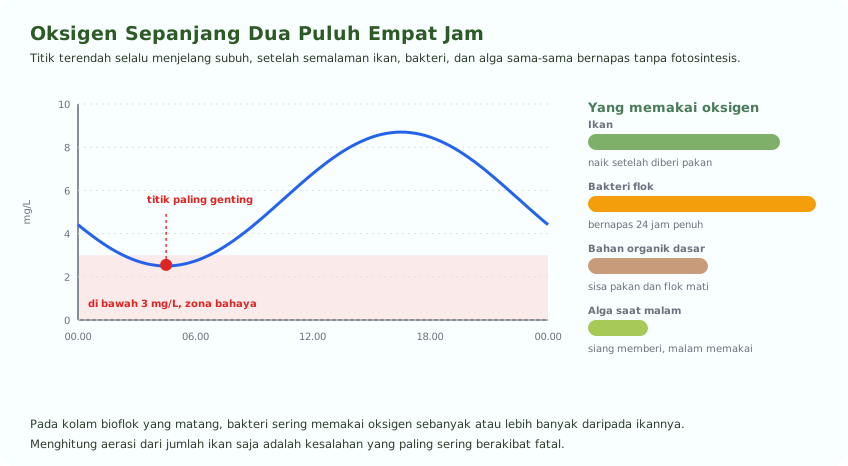
Fish
The bigger and the more numerous they are, the more they use. It rises sharply after feeding and when the water temperature is high.
Floc bacteria
They breathe twenty-four hours a day. The denser the floc, the more they use. This is the one that often gets forgotten.
Organic matter on the bottom
Leftover feed and dead floc breaking down. It piles up quietly until one night it uses up the oxygen.
Water temperature
Warm water holds less oxygen. At 32 degrees, the oxygen the water can hold is far below what it is at 26 degrees.
Reading the Signs Before It Is Too Late
The fish tell you, usually about an hour ahead
| Oxygen level | What you see in the fish | Danger level |
|---|---|---|
| Above 5 mg/L | Spread out evenly, eating eagerly | Safe |
| 4 to 5 mg/L | Still normal, appetite slightly down | Caution |
| 3 to 4 mg/L | Gathering near the aerator, feed left over | Danger, act now |
| 2 to 3 mg/L | Hanging at the surface, mouths gasping | Critical |
| Below 2 mg/L | Swimming weakly, some starting to die | A mass die-off is under way |
Sizing and Arranging the Aeration
The number of points matters more than the size of the blower
-
Choose the blower from water volume, not pond area
The common rule for biofloc at high stocking density is about 2 to 3 liters of air per minute for every cubic meter of water. A D3 pond with one meter of water holds about 7 cubic meters, so it needs about 15 to 21 liters per minute.
-
Add more aeration points, do not rely on one big point
Four small air stones spread out are far better than one big stone in the middle. What you want is not big bubbles, it is fine bubbles spread evenly and a current that turns the whole body of water.
-
Place the air stones near the bottom, but not touching it
About five to ten centimeters off the bottom. Resting on the bottom stirs the sludge up constantly, too high leaves the bottom layer out of the circulation.
-
Aim the current so it circles, not so it fights itself
In a round pond, arrange the aeration points so the water turns one way. That rotation is what carries the sediment to the middle and into the central drain pipe.
-
Check the dead spots every week
Measure the oxygen at the point where the current is weakest, usually at the edge opposite the blower. The reading at that point decides the fate of the pond, not the reading in the middle.
Questions About This Module
What participants ask most often
What size blower does a biofloc pond need?
The common rule for biofloc at high stocking density is about 2 to 3 liters of air per minute for every cubic meter of water. A pond three meters across with one meter of water holds about 7 cubic meters, so it needs about 15 to 21 liters of air per minute.
Work it out from water volume, not from the pond surface area. And remember that in biofloc the bacteria also use as much oxygen as the fish or more, so do not size it from the fish count alone.
Why do the fish hang at the surface in the morning?
Because dissolved oxygen hits its low point just before dawn. All night the fish, the bacteria, and the algae all breathe with no photosynthesis adding oxygen.
If the fish are already gasping at the surface, the oxygen is probably below 3 mg/L and you are about an hour late. Turn on every aerator, stop feeding, and spray water from a height to break the surface. Once it is safe, add more aeration points so it does not happen again.
Can a biofloc pond run without an aerator?
No, not if you mean real biofloc. Floc is a living colony of bacteria that breathe, and those bacteria are the biggest oxygen user in the pond. As soon as the aeration stops, the oxygen is gone within hours, the floc dies and settles, and then the ammonia spikes.
What people call catfish without an aerator is really a pond at ordinary stocking density that relies on the catfish being able to take air from the surface. That can work, but the stocking density has to be far lower and the water has to be changed regularly.
How long does a pond last if the power goes out?
In biofloc at high stocking density, two hours at night is enough to lose everything in the pond. During the day there is a little more room because the algae are still producing oxygen, but it is still dangerous.
That is why a battery-powered backup blower or a generator is a requirement, not an option. Test-run it once a month. A generator that is never started usually fails exactly when it is needed.
All the modules can be read in order or skipped through as needed. See the fish farming training list, or all training tracks.