Fruiting Plants Have to Be Shaped, Not Left Alone
What you prune is not the damaged part but the excess
Left alone, tomato, bell pepper, eggplant and cucumber grow into a bush. Many branches, dense leaves, small fruit that ripens unevenly. All the energy is split across too many points.
Shaping a plant means deciding from the start where that energy goes. This is routine work, not occasional work, and the difference shows plainly in the size and uniformity of the fruit.
Pruning and Trellising
Six jobs that repeat all season
-
Put up stakes and support strings early
Fruiting plants in a greenhouse hang from a string tied to the frame above, and the string is wound around the stem as the plant grows. Putting it up later means the stem is already bent.
-
Decide how many main branches
Bell pepper and chili are usually left with two branches. Tomato and eggplant with one. The rest are removed while still small, because a small wound closes much faster.
-
Remove side shoots every day
The shoots that appear in the leaf axils of tomato grow very fast. Left for a week, one becomes a full branch, and removing it then wounds the plant. This is daily work, not weekly.
-
Thin the fruit
Leave three to five fruits per truss on tomato, and one fruit per node on bell pepper. Too much fruit makes all of it small, and none reaches a size worth selling.
-
Remove the lower leaves on time
Old leaves below a fruit truss no longer contribute much. Removing them opens up airflow, cuts down hiding places for pests, and speeds up ripening.
-
Lower the plant once it reaches the roof
The string is loosened and the stem laid over to the side a little at a time, so the growing tip stays at working height. Done this way, one plant can produce for far longer.
| Crop | Start from | Main reason |
|---|---|---|
| Tomato | About 1.5 months after transplanting | Speeds up ripening and prepares the plant for lowering |
| Eggplant | About 2 months after transplanting | Opens up airflow and reduces the load on the plant |
| Bell pepper | About 2 months after transplanting | More light reaches the fruit, so the color is even |
Reading and Steering Growth
The skill that sets an experienced grower apart
A fruiting plant always leans one of two ways. Vegetative means it is busy building leaves and stem. Generative means it is busy forming flowers and fruit. Both are needed, but neither should go too far.
A plant that is too vegetative grows lush and green but sets little fruit. A plant that is too generative fruits heavily, then runs out of strength, its stem thins, and in the end it stops producing. Your job is to keep it in the middle.
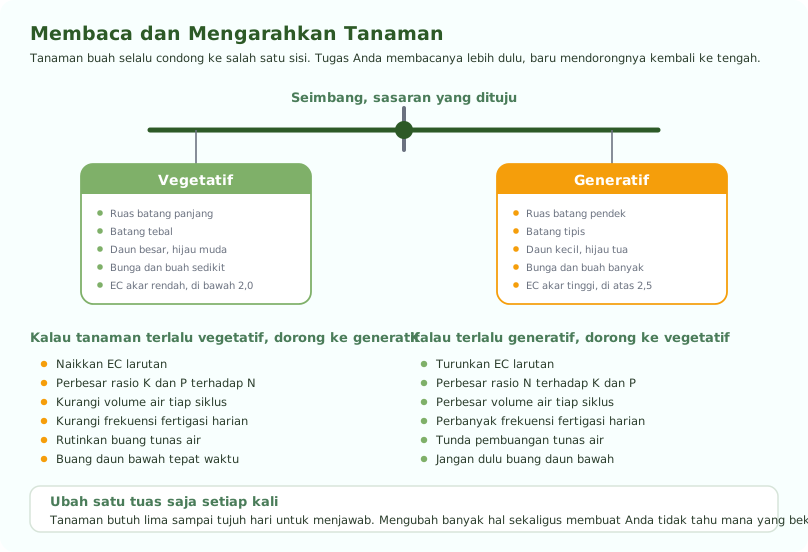
How to read it in the field
| What to look at | Leaning vegetative | Leaning generative |
|---|---|---|
| Internode spacing | Long | Short |
| Stem thickness | Thick | Thin |
| Leaf size and color | Large, light green | Small, dark green |
| Number of flowers | Few | Many |
| Fruit size | Large but few | Small but many |
| EC at the root zone | Low, below 2.0 | High, above 2.5 |
Climate Inside the Greenhouse
Shade, airflow and flowering
Shade net
| Condition | Shade net open | Reason |
|---|---|---|
| Dry season | 9am to 2pm | Peak heat lasts longest |
| Normal day | 11am to 1pm | Only during the hottest hours |
| Rainy season | Left open | Light is already low, the plants need what is left |
A shade net protects plants from wilting at midday, from bolting, which is lettuce rushing into flower, and from fruit skin scorched by direct sun. It also holds down evaporation, so the plant does not lose water faster than the roots can take it up.
Airflow
Open the greenhouse side windows in the morning so the damp overnight air is replaced. Trapped humidity is an open invitation to powdery mildew and leaf spot.
Removing the lower leaves and keeping the plant spacing right matter as much as opening the windows. Air has to pass between the plants, not only above them.
Helping flowering
In a closed greenhouse, pollinating insects do not get in. For tomato and eggplant the flowers need help, either by shaking the support strings every morning or with a fruit-set stimulant.
If you use a stimulant, the time is around nine in the morning when the flowers are fully open, repeated every other day. Follow the directions on the package, because too high a dose gives deformed, seedless fruit.
Questions About This Module
What participants ask most often
Why do side shoots on tomato have to be removed every day?
Side shoots grow in the leaf axils and develop very fast. Left for a week, one becomes a full branch that takes energy from the fruit, and removing it then means a large wound that becomes an entry point for disease.
Removed every day while they are still a few centimeters long, they leave only a small wound that closes within hours. This is a five minute job that decides the size of your fruit.
How many branches should be left on bell pepper and tomato?
Bell pepper and chili are usually left with two main branches, while tomato and eggplant get one. The rest are removed while still small.
For the fruit, tomato is left with three to five fruits per truss, and bell pepper one fruit per node. Letting every fruit grow makes them all small, and none reaches a size worth selling.
What does lowering the plant mean?
When a tomato plant reaches the greenhouse roof, its support string is loosened and the lower stem is laid over to the side a little at a time. The growing tip comes back down to working height, so the harvest stays within reach of your hands.
It usually starts about two weeks after the first harvest, then repeats every two weeks. Done this way, one plant can produce for far longer than if it were left to stop at the roof.
How do you tell whether a plant is too vegetative or too generative?
Look at the internode spacing, the stem thickness and the leaf size. Long internodes, a thick stem and large light green leaves mean the plant is too vegetative. Short internodes, a thin stem and small dark green leaves mean it is too generative.
To push it toward generative, raise the EC, widen the ratio of potassium and phosphorus to nitrogen, cut the fertigation frequency, and remove the lower leaves on time. To push it toward vegetative, do the opposite. Change only one thing at a time, then wait five to seven days.
When should the shade net be open?
In the dry season from about nine in the morning to two in the afternoon, on a normal day eleven to one is enough, and in the rainy season it is left open because light is already low.
A shade net protects plants from wilting, from lettuce rushing into flower, and from fruit skin scorched by direct sun. Closing it for too long leaves the plant short of light and growing leggy.
All the modules can be read in order or skipped through as needed. See the hydroponics training list, or all training tracks.