Choosing Fingerlings, a Decision You Cannot Redo
No feed, however good, can fix bad fingerlings
One production cycle runs two to four months. If the fingerlings are weak from day one, you spend all that time raising a loss. So choosing fingerlings deserves more care than haggling over their price.
| What to look at | Good fingerlings | Fingerlings to reject |
|---|---|---|
| Size within one container | Uniform, small spread | Widely mixed, some much bigger |
| Movement | Lively, swimming against the current, spreading out evenly | Still at the bottom, swimming tilted, crowding in corners |
| Color and body surface | Bright, scales and mucus intact | Pale, wounds, frayed fins, white spot |
| Reaction when the container is touched | Dart away at once, all together | Slow to react or no reaction at all |
| Origin and history | Known hatchery, with broodstock and feed records | Origin unknown, no records |
Acclimation, the Fifteen Minutes That Decide
A sudden move kills more fingerlings than disease
-
Turn off or dim the light, do not stock in the midday heat
Stock in the morning before eight or in the afternoon after four. Pond water temperature is closest to the transport water temperature at those hours.
-
Float the fingerling bag on the pond surface for 15 to 20 minutes
This equalizes the temperature without mixing the water. A difference of more than 3 degrees is already enough to stress the fingerlings, and a difference of 5 degrees can kill them.
-
Open the bag, add pond water a little at a time
Add about a quarter of the bag volume every five minutes, three to four times. This equalizes pH, salinity, and other dissolved content gradually.
-
Tilt the bag and let the fingerlings swim out on their own
Do not pour or dump them out. Far fewer fingerlings are stressed when they leave of their own accord. The water from the bag should not go into the pond.
-
Fast the fingerlings on the first day
Do not feed on stocking day. The fingerlings' gut is still upset from the trip, and feed that is not eaten only turns into ammonia.
-
Count the deaths in the first 24 to 48 hours
Deaths in the first two days point to a transport or acclimation problem. Deaths that start on the fifth day or later usually point to a water quality problem or disease.
Stocking Density
A number you must match to your aeration, not to your wishes
| System | Tilapia (fish per cubic meter) | Catfish (fish per cubic meter) | Requirement |
|---|---|---|---|
| Traditional earthen pond | 5 to 10 | 50 to 100 | No added aeration |
| Plain tarpaulin pond | 20 to 50 | 100 to 200 | Light aeration, routine water changes |
| Biofloc | 100 to 150 | 200 to 400 | 24-hour aeration, backup power required |
| Intensive biofloc, experienced growers | Up to 200 | Up to 500 | Strict daily monitoring, not for beginners |
Catfish tolerate two to three times the stocking density of tilapia because they have an arborescent organ that lets them take air straight from the surface. Tilapia do not have it, and depend entirely on dissolved oxygen.
Beginners should always start at the lower limit. High stocking density demands equally high aeration, feed, and measuring discipline, and failure at high density happens far faster.
Grading
The job most often postponed, and the most expensive in its consequences
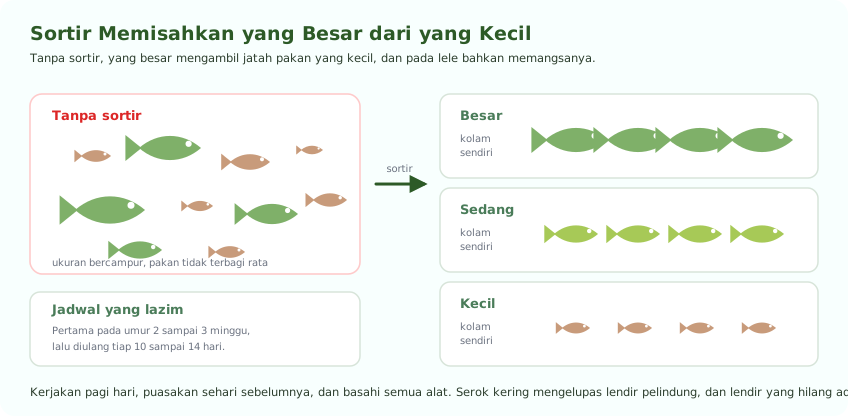
Within one pond, fish do not grow uniformly. The bigger ones eat more and grow faster still, while the small ones fall further behind. With catfish, the big ones even eat the small ones.
Grading separates them into different ponds so each group gets the feed that fits it and the small ones get a chance to catch up.
| Age | Average size | Grading interval | What to watch |
|---|---|---|---|
| 2 to 3 weeks | About 3 to 5 cm | First grading | Most fragile, the fingerlings are still very soft |
| 1 month | About 5 to 8 cm | Every 10 to 14 days | Cannibalism starts to show up here |
| 2 months | About 8 to 12 cm | Every 2 weeks | The size spread is at its widest |
| Near harvest | Market size | Once before harvest | Also evens out the selling size |
How to grade without stressing the fish
-
Fast the fish the day before
An empty gut means less waste in the sorting tub and lower oxygen use while the fish are crowded.
-
Work in the morning while the temperature is still low
Cooler water holds more oxygen and the fish stay calmer. Avoid the midday heat entirely.
-
Use a graded tub or a perforated bucket, not your hands
A sorting tub with stepped slots separates sizes without much handling. Hands and rough nets damage the protective mucus on the body.
-
Wet every tool first
A dry net or tub sticks to the fish's mucus and strips it off. Lost mucus is an entry point for fungus and bacteria.
-
Work fast, do not let the fish pile up for long
Keep each batch to a few minutes only. Provide aeration in the holding tub if there are a lot of fish.
-
Add salt to the destination pond after grading
A low dose of salt helps the mucus recover and eases osmotic pressure. Fast the fish for another day after grading before resuming feed.
Questions About This Module
What participants ask most often
How often should catfish be graded?
The first grading is at two to three weeks old, then repeated every ten to fourteen days until near harvest. This interval follows growth rate, not a fixed date.
What actually decides it is not age but the size spread. As soon as a clearly larger group shows up, that is the time to grade. Delaying means letting the big ones eat the small ones and take their share of the feed.
How do you grade catfish without stressing them?
Fast them the day before, work in the morning while the temperature is still low, and use a graded sorting tub, not your hands. Wet every tool first so the protective mucus on the fish is not stripped off.
Work fast and do not let the fish pile up for long in a tight container. When you are done, add a low dose of salt to the destination pond to help the mucus recover, then fast them for another day before resuming feed.
What is the catfish stocking density in a tarpaulin pond and in biofloc?
A plain tarpaulin pond with light aeration and routine water changes can handle 100 to 200 fish per cubic meter. A biofloc system with 24-hour aeration can handle 200 to 400 fish per cubic meter.
For tilapia the numbers are far lower: 20 to 50 in a plain tarpaulin pond and 100 to 150 in biofloc. Catfish tolerate higher density because they can take air straight from the surface, while tilapia depend entirely on dissolved oxygen.
What is the right way to acclimate fingerlings?
Float the fingerling bag on the pond surface for fifteen to twenty minutes to equalize the temperature. After that, open the bag and add pond water a little at a time, about a quarter of the bag volume every five minutes, three to four times.
Tilt the bag and let the fingerlings swim out on their own, do not pour them. The water from the bag should not go into the pond. Fast the fingerlings on the first day, because feed that is not eaten only turns into ammonia.
Why do many fingerlings die a few days after stocking?
When they die tells you the cause. Deaths in the first 24 to 48 hours are almost always from rushed transport or acclimation, especially too wide a temperature difference.
Deaths that only start on the fifth day or later usually point to water quality, commonly ammonia rising because the floc has not formed yet, or disease carried over from the hatchery. Check ammonia, nitrite, and oxygen first before assuming disease.
All the modules can be read in order or skipped through as needed. See the fish farming training list, or all training tracks.